There’s been a growing conversation around the term “third spaces,” places we can escape to that aren’t home or work. When I talk about third spaces, I’m referring to those informal, welcoming places where people can connect, gather, or simply be. These spaces serve as pockets of community, offering opportunities to socialize and build authentic relationships outside of our routines. I recently had a conversation with a coworker who claimed, “There’s nothing to do outside of work, especially nothing free or low-cost.” I couldn’t disagree more. Third spaces do exist. In exploring this topic, I’ve discovered several meaningful experiences that cost very little aside from time and travel.
What Are Third Places?
Third places refer to the social environments beyond the two primary ones: home (first place) and work (second place). These are spaces where you don’t need an invitation or appointment. You can show up as you are, come and go freely, and feel like you belong. Successful third spaces are informal, comfortable, and ideally located near your neighborhood. They shouldn’t require significant financial investment. Think cafés, libraries, community centers, parks, gyms, churches, bookstores, museums, or even barbershops. These spaces play a crucial role in civic engagement and community building by creating a neutral ground for connection.
Finding Places to Go
Many people are under the impression that third spaces have disappeared or simply don’t exist but more often, they just aren’t looking. As someone who naturally enjoys wandering and exploring, I’ve come across plenty of creative and affordable third places that spark joy and curiosity. I’m located near Phoenix, Arizona. Below are a couple of places I enjoy.
Take IKEA, for instance. I love interior design, so walking through its showrooms inspires me to imagine the kind of home I want to create. It’s a playful, free, and imaginative experience. They also have an affordable Swedish café, which makes it a complete outing. Another favorite is the Phoenix Art Museum. On Wednesdays, they offer a “Pay What You Wish” admission policy. It’s essentially free if you want it to be. Museums like this provide both aesthetic nourishment and opportunities for connection through the love of art. Many cities have similar programs; just check your local policies.
The Stigma Around Third Places
Despite their value, third spaces are often misunderstood or, worse, stigmatized. Some spaces implement exclusionary designs like anti-homeless architecture, such as benches made to prevent resting. Others, like cafés, have been criticized for focusing more on profit than people. Shopping centers, too, can feel overly commercial, fast-paced, and disconnected. When third places become unwelcoming or inaccessible, people experience greater isolation and disconnection. That impacts mental health, leading to increases in anxiety and depression. In contrast, inclusive third spaces can address loneliness, encourage political engagement, and even contribute to climate resilience. A true third space offers neutral ground, centers conversation, encourages regular participation, and maintains a light-hearted, low-pressure atmosphere.
Barriers to Access and Equity
Not every community has access to third spaces, and barriers such as cost, location, safety, and disability inclusion matter. Gender and racial identities also deeply shape how people experience public space. For instance, women and people of color often encounter challenges. These experiences can range from feeling unsafe or unwelcome, leaving some to be subjected to harassment or discrimination.
It’s also important to acknowledge capitalism’s role in shaping modern leisure. Public leisure has increasingly become commercialized, turning what was once free or gathering into a profit-driven activity. Shopping malls, entertainment complexes, and resorts often dominate these conversations, overshadowing grassroots or accessible options.
The Library as a Powerful Third Space
If you’re unsure where to start, start with the library. My local library has become one of my favorite third spaces. It offers far more than just books. One branch near me provides free Culture Passes that grant admission to museums, zoos, botanical gardens, and other cultural institutions across the city. All you need is a library card.
Libraries also offer access to laptops, telescopes, coding classes, college prep resources, and entrepreneur workshops. Some even have entire floors dedicated to children’s enrichment. I’ve discovered incredible authors and entire genres I never would’ve explored otherwise, just by showing up.
Libraries are gateways. They don’t just offer resources; they connect you to other third spaces. You just have to be open to looking.
Reclaiming Third Spaces
Reclaiming third spaces means re-energizing the places where people gather, unwind, and create meaning outside of their daily obligations. These spaces don’t have to be trendy or high-tech. All they need is intentionality, a commitment to fostering ease, inclusion, and connection.
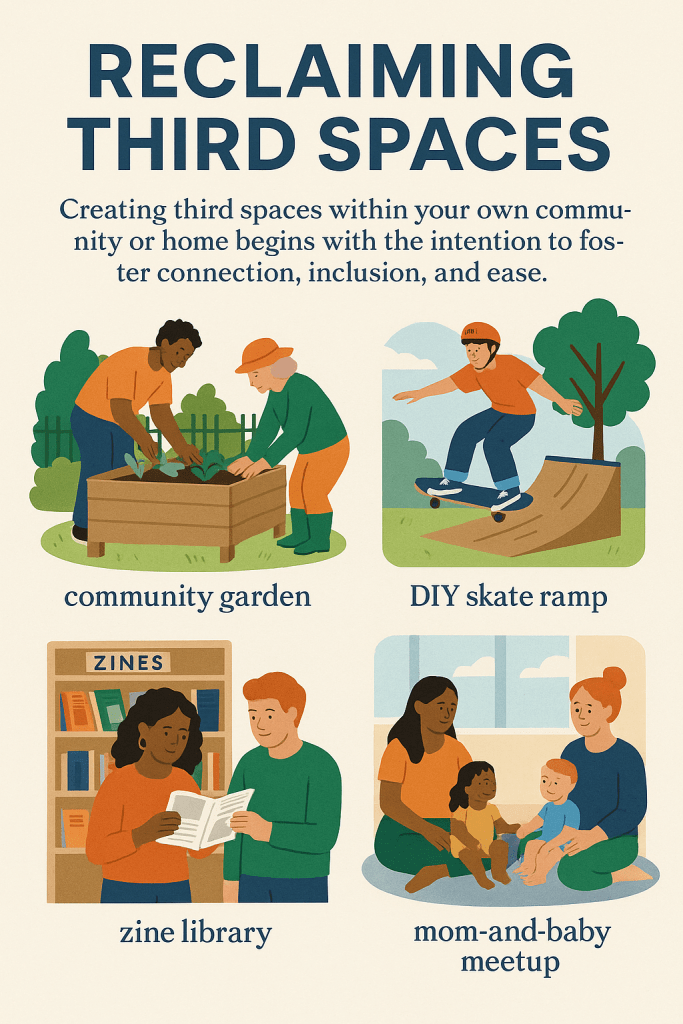
Start small: repurposed a neglected patch of land into a garden, a skate ramp, or a local meet-up spot. Many third spaces already thrive in communities, zine libraries, book exchanges, art collectives, mom-and-baby meetups, and backyard open mics. These spaces thrive not because of funding, but because of people who care.
Whether it’s a cozy living room turned into a story circle or a front porch where neighbors chat every evening, these third places reflect the heart of their communities.
The Conclusion
Third spaces are essential for fostering connection, empathy, and belonging. They support well-being by giving people places to gather, share, and simply exist together, outside the confines of productivity. When we engage in these spaces, we strengthen the social fabric of our neighborhoods, creating emotional resilience and promoting shared identity.
Despite the challenges and stigmas, third places remain vital. They remind us to slow down, make eye contact, and lean into community. Whether in a humble library, a hidden park, or a small corner café, these spaces hold the power to transform how we live and relate to one another. As we move forward, the opportunity is clear: creating and protecting third spaces is not just for ourselves, but for the generations who will one day need them just as much as we do. Because when we invest in third spaces, we’re not just building places, we’re nurturing belonging.
Supporting Evidence
The term third space is
*Coined by sociologist Ray Oldenburg.
*Not home (first space) or work (second space), but a neutral, public place that fosters informal social interaction.
*Examples: Cafes, libraries, parks, salons, bookstores, co-ops, churches, community centers.
The book The Great Good Place (1989), by Ray Oldenburg, argues that third places are important for democracy, civic engagement, and a sense of place. Oldenburg’s coauthor Karen Christensen argues in the 2025 sequel that third places are the answer to loneliness, political polarization, and climate resilience. She also clarifies the difference between third places and public spaces. Public spaces are areas open to everyone. Think of places such as parks and town squares, while third places are specific, informal social settings, distinct from home and work, where people regularly gather to socialize, like coffee shops or community centers. Digital-only spaces don’t fully count unless they mirror the qualities of physical gathering.
*Source: Oldenburg, Ray. The Great Good Place. Marlowe & Company, 1999.
Studies show that regular participation in community spaces significantly lowers feelings of loneliness and increases emotional resilience. A 2021 survey by the American Psychological Association noted a strong link between social connection and mental well-being.
*Quote: “Social connectedness improves physical health and mental and emotional well-being.” — APA, 2021
*According to a 2019 report by The Brookings Institution, low-income communities and communities of color have less access to inclusive public spaces, often due to zoning, disinvestment, or gentrification.
*A 2020 article in CityLab reported that access to third spaces increases civic participation, trust in local governance, and neighborhood stability.
 Catalogue