Happy May 2026!
It’s graduation season ! Congratulations to all the graduates for your remarkable accomplishments and unwavering dedication throughout this year. Your perseverance and commitment have allowed you to successfully complete your degree and leave an indelible mark on our nation.
As an upcoming graduate myself, completing my final semester toward my second degree, I have been sitting with a question I suspect many graduates share: Is all of this still worth it?
That question got louder for me after what happened at Glendale Community College on May 15, 2026. It started as a commencement ceremony and ended as a conversation the entire country needed to have
Colleges and Artificial Intelligence
We have some professors who want you to avoid using ChatGPT for assignments, while others encourage its use for research, despite having strict AI guidelines. Glendale Community College (GCC) in Arizona faced major backlash during its May 15, 2026 commencement ceremony after an AI system used to read graduates’ names malfunctioned. The AI skipped dozens of names, misread others, and froze, causing loud booing and frustration among students and families. Graduates scanned cards as they walked across the stage, but the AI frequently misaligned the names being spoken with the graduates, and even froze the scrolling screen of names.
Parents and students were visibly upset as many graduates didn’t get their names announced. GCC President Tiffany Hernandez addressed the crowd to explain the AI system that was being used was not working properly, which was met with boos!
After the malfunctions stalled the ceremony, school officials halted the AI reader and switched to a human announcer to finish the event. The college later issued apologies, calling the AI rollout a “lesson learned”.
As a Gcc graduate of 2023 I felt disappointed. A commencement ceremony is one of the most important milestones in a student’s academic journey. Families travel, take time off work, and gather to celebrate years of hard work and sacrifice. While AI can be a useful tool in many settings, this situation highlighted the importance of human oversight and the risks of relying too heavily on technology during significant life events.
Technology should enhance these moments, not diminish them. Sometimes the simplest solution is a trained person reading names, as this still remains the most reliable and respectful option.
The malfunction at Glendale Community College was more than just an embarrassing technical failure; it sparked a national conversation about education, accountability, and the future of what we consider acceptable forms and uses of knowledge.
For many, it symbolized a growing concern: Are we becoming so focused on innovation that we are neglecting the purpose of education itself?
As a GCC graduate of 2023, I found the incident disappointing, but it also forced me to think about larger questions. What is the value of education in 2026? What role should artificial intelligence play in learning? And perhaps most importantly, what does it mean to be educated in an era where information is available instantly?
The Conversation Surrounding Degrees and credentials
The debate surrounding education has intensified in recent years, especially as public figures, employers, and educators question whether traditional degrees still hold the same value they once did. One voice that has become increasingly prominent in this discussion is Dr. Cheyenne Bryant.
The same week as the GCC malfunction, another story was dominating feeds: wellness influencer and MTV personality Dr. Cheyenne Bryant was heavily in the media due to a major online controversy surrounding her professional credentials. She after admitting she is not a licensed therapist and refusing to provide proof of her doctoral degree. Critics and former students questioned her doctorate from Argosy University. Bryant explained on The Breakfast Club that she could not provide her transcripts because the school permanently shut down and wiped student records, though critics argued other alumni were still able to retrieve their paperwork. During podcast and radio interviews, Bryant often claimed that she is a life coach rather than a licensed therapist. This caused an uproar, as many clients and viewers believed she was a licensed psychologist. However, Bryant stood firm on continuing to use her title, “Doctor” stating on The Marissa Mitchell Show that she “earned the title” and her obedience is to God, not to public demands for proof.
This widespread online debate have sparked broader discussions across major publications like Forbes about the blurred lines between licensed mental health experts and internet life coaches, particularly regarding accountability and ethics. Do you need a degree to become a master of your subject of Choice?
The honest answer is nuanced. A degree does not automatically confer mastery, and mastery can exist without a credential. But in fields where people’s mental health, physical safety, or legal rights are at stake, the credential exists for a reason, it represents training, oversight, ethical accountability, and liability. Calling yourself a doctor while building an audience that believes they are receiving therapeutic care is a different matter than simply being knowledgeable.
The Bryant controversy is not really about one person. It is about what happens when trust gets marketed without accountability, and why understanding what degrees actually mean has never been more important!
What Are The Degrees
Associate Degree
Typically earned in two years, an associate degree serves as either a workforce credential or a foundation for further education. Community colleges have historically provided affordable access to higher education, allowing students to enter skilled careers or transfer to four-year universities.
Bachelor’s Degree
The bachelor’s degree is designed to provide both specialized knowledge and a broad educational foundation. Students learn discipline-specific skills while developing critical thinking, communication, research, and analytical abilities.
Master’s Degree
A master’s degree builds advanced expertise in a specific field. It often focuses on leadership, specialization, professional application, and advanced research.
Doctoral Degree
Doctoral degrees represent the highest level of academic achievement. Whether a Ph.D., Ed.D., Psy.D., M.D., or another professional doctorate, these programs are designed to develop experts who CONTRIBUTES original knowledge, conduct research, or practice at the highest professional level!
Why Accreditation Is the Detail Most Students Miss
Not all degrees are created equally, and the difference often comes down to accreditation. One of the least understood aspects of higher education.
Not all degrees are created equally. Historically, regional accreditation has been considered the gold standard in American higher education. Most public universities, state colleges, and traditional nonprofit institutions fall into this category.
Regional accreditation generally offers:
- Greater transferability of credits
- Higher academic standards
- Wider employer recognition
- Easier admission into graduate programs
National Accreditation
National accreditation often applies to vocational, technical, career-focused, or specialized institutions.
While nationally accredited schools can provide valuable education, students may encounter challenges when:
- Transferring credits
- Applying to graduate schools
- Seeking professional licensure in certain fields
Many students discover these differences only after spending significant time and money pursuing a degree.
In 2026, understanding accreditation is just as important as choosing a major because the quality and recognition of an education can impact opportunities. Argosy University, notably, held regional accreditation before its collapse, which is part of why its closure created such complicated situations for graduates trying to retrieve their records.
“Professional” Degrees and Funding
However, What has further complicated the conversation is the growing debate over what constitutes a “professional degree” in today’s economy. Traditionally, professions such as medicine, law, engineering, accounting, education, and psychology required specialized degrees, licensure, and extensive training. However, with the rise of technology, artificial intelligence, cybersecurity, digital marketing, data analytics, cloud computing, and skilled trades has expanded the definition of professional expertise.
As of now, a “professional degree” is officially defined by the U.S. Department of Education as a graduate-level program that signifies the completion of academic requirements to begin practice in a specific profession. Which typically requires at least six years of postsecondary education, culminates in a doctoral-level credential, and leads to mandatory professional licensure.
The 11 Recognized Professional Degree Programs
During the 2026 negotiated rulemaking and Notice of Proposed Rulemaking (NPRM) process, the federal government defined professional degrees very narrowly to only include 11 specific disciplines:
- Law (J.D., LL.B.)
- Medicine (M.D.)
- Osteopathic Medicine (D.O.)
- Dentistry (D.D.S. or D.M.D.)
- Veterinary Medicine (D.V.M.)
- Pharmacy (Pharm.D.)
- Optometry (O.D.)
- Podiatry (D.P.M.)
- Chiropractic (D.C.)
- Theology (M.Div., M.H.L.)
- Clinical Psychology (Added during the 2026 negotiations)
The primary reason for this strict classification in 2026 is federal student loan limits, which were significantly restructured to curb over-borrowing and rising tuition costs. Because these degrees require high-cost, multi-year commitments to enter critical fields, for professional students in the 11 recognized programs are eligible for a higher aggregate borrowing limit of up to $50,000 per year (with a $200,000 lifetime cap) For Standard Graduate Students in other highly specialized post-baccalaureate programs (such as advanced nursing [MSN, DNP], physical therapy, social work, and public health) are classified simply as “graduate students.” They face stricter lending caps, usually limited to $20,500 per year (with a $100,000 lifetime cap).
This narrow distinction has sparked significant pushback in 2026. Prominent healthcare and educational organizations have actively lobbied to expand this list. They argue that excluding advanced medical professionals like Nurse Practitioners and Audiologists disregards the rigorous, licensure-bound nature of their training and unfairly restricts their access to essential educational funding. This harsh shift has created confusion for students attempting to determine the best return on investment for their education.
The System Beneath the Degrees
Test scores in reading and math have reached their lowest levels in decades, failing to recover to pre-pandemic benchmarks. Reading scores have dropped in 83% of U.S. school districts. On average, students are roughly six grade levels behind where their peers stood a decade ago, with declines in math and reading performance traceable back to 2013.
Meanwhile, teachers and districts are navigating a surge in behavioral challenges, student apathy, and mental health crises, compounded by unrestricted access to technology and social media that contributes to sleep deprivation, focus problems, and a doomscrolling culture that undercuts learning before a student ever enters a classroom.
The roots of this run deeper than AI. The No Child Left Behind Act, well-intentioned in its focus on accountability, unintentionally shifted education toward performance on standardized assessments rather than genuine intellectual development. Students learned how to pass tests. But did they learn how to think? How to evaluate information? How to distinguish fact from misinformation? How to ask meaningful questions?
Those questions have never mattered more than they do right now.
Test scores in reading and math have reached their lowest levels in decades, failing to recover from pre-pandemic benchmarks. Reading scores have dropped in 83% of U.S. school districts. On average, American students are roughly 6 grade level behind where their peers stood a decade ago In many districts, math and reading performance has been declining since 2013. Student Mental Health and Safety has become a great concern. Teachers and districts are grappling with a surge in behavioral outbursts, student apathy, and mental health struggles. Additionally, unrestricted access to technology and social media outside of school is contributing to sleep deprivation, focus issues, and a “doomscrolling” culture that severely impacts student performance.
For decades, Americans were told that attending college was the primary pathway to success. While education continues to be a powerful tool for upward mobility, today’s students face a more complex landscape compared to previous generations ever were!
Blame The No Child Left Behind Act?
The roots of today’s educational challenges extend far beyond artificial intelligence.
The No Child Left Behind Act sought to improve educational outcomes through accountability and standardized testing. While it succeeded in bringing attention to achievement gaps, critics argue that it unintentionally shifted the focus toward test performance rather than genuine learning.
Students learned how to pass assessments.
But did they learn how to think?
Did they learn how to evaluate information?
Did they learn how to distinguish facts from misinformation?
Did they learn how to ask meaningful questions?
Those questions have become increasingly important in the AI era. However, Artificial intelligence has not made education obsolete. It has made a genuine education more valuable than ever.
AI can generate essays. It can summarize books, write code, and answer questions at scale. What it cannot do is replace human wisdom. Information is now abundant to the point of overwhelming. Wisdom remains scarce.
The students who will thrive in the next decade will not be those who can memorize the most facts. They will be those who can evaluate information, recognize bias, think critically, solve problems with creativity, communicate with clarity, and apply knowledge ethically. None of those capacities can be outsourced to a machine.
For thousands of years, civilization preserved knowledge through storytelling, books, libraries, universities, apprenticeships, and mentorship. AI is becoming another tool in that process. The challenge is ensuring it remains a tool rather than becoming a replacement for the learning itself. That requires:
Reading deeply, not just skimming AI summaries
Studying history to understand the context behind current events
Developing writing as a practice for clarifying thought, not just producing output
Practicing critical evaluation of AI-generated information
Engaging meaningfully with teachers, mentors, and peers
Preserving human creativity alongside technological advancement
The goal is not to compete with artificial intelligence. The goal is to become more fully human.
Why Education Matters More Than Ever
Ironically, AI has not made education less important.
It has made education more important.
Artificial intelligence can generate essays.
It can summarize books.
It can write code.
It can answer questions.
What it cannot do is replace human wisdom.
Knowledge and information are not the same thing.
Information is abundant.
Wisdom remains scarce.
The students who will thrive in the future will not necessarily be those who can memorize the most information. They will be those who can evaluate information, recognize bias, think critically, solve problems creatively, communicate effectively, and apply knowledge ethically. AI is now becoming another tool in that process.
The Future of Education
The GCC commencement malfunction will probably be remembered as a small incident in a much larger story. But the moment itself was instructive: a system designed to celebrate student achievement failed, and humans stepped in to finish the job.
That is the pattern worth holding onto. Technology is powerful. AI is genuinely transformative. But education has always been about more than efficiency. It is about passing knowledge from one generation to the next. It is about cultivating wisdom, character, curiosity, and the capacity to understand, not just to retrieve.
A degree alone does not make someone a master of their subject. Mastery comes through continuous learning, experience, discipline, and sustained application over time. Degrees still serve a genuine purpose: they convey rigor, open professional opportunities, and, in high-stakes fields, establish accountability structures that safeguard the individuals they serve.
Students today must become informed consumers of education. Too many discover the differences between accreditation types, degree values, and career outcomes only after making decisions that cost years and real money. That has to change.
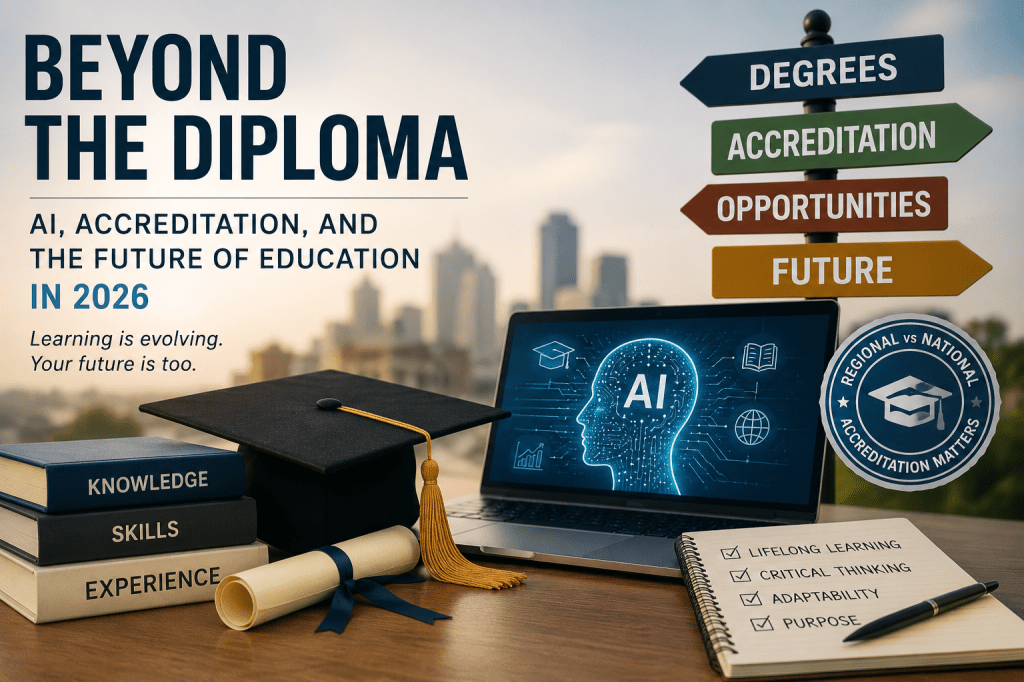
The future of education will not belong only to those who earn degrees. It will belong to those who keep learning, keep adapting, and keep thinking long after graduation.
The question is not whether AI will shape education. It already has. The question is whether we will shape our relationship with AI in a way that preserves what education is actually for: the development of people who can think, discern, create, and lead with wisdom.
Based on everything this month has shown us, that work is more urgent than ever.
Conclusion
If we can combine human judgment, strong educational foundations, technological innovation, and a commitment to lifelong learning, education in 2026 can become stronger than ever before. As a behavioral health professional, I challenge us to recognize that a degree alone does not equate to mastery in a chosen subject. True mastery is achieved through continuous learning, accumulated experience, disciplined practice, and the application of knowledge. At the same time, degrees still serve and persevere an important role in opening doors to professional opportunities and demonstrating academic achievement knowledge and skills. As we reflect on policies such as No Child Left Behind, the growing influence of AI in education, and the importance of understanding regional versus national accreditation, students must become informed consumers of education. Too many discover critical differences in degree value, accreditation, and career outcomes only after investing significant time and money. The future of education will belong not only to those who earn degrees, but to those who continue learning, adapting, and thinking critically long after graduation.


Leave a Reply